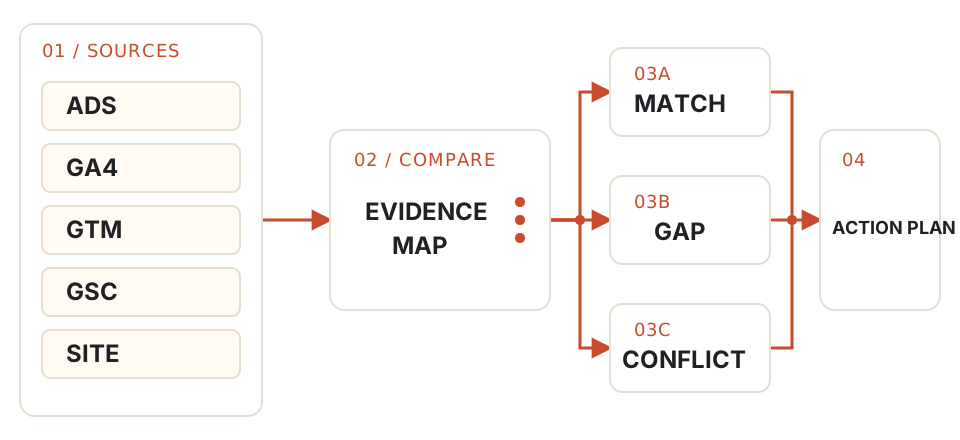
Evidence map
Review the agreed Google Ads, GA4, GTM, Search Console and site-tracking evidence to identify where systems disagree.
Google Ads audit & analytics
Most connects Google Ads with GA4, GTM, Search Console and your site's tracking code — as far as the agreed scope and granted access allow — then turns the evidence into a prioritized action plan.
Independent service, not affiliated with or endorsed by Google. Access only with your authorization.
Services
The work turns cross-system evidence into clear deliverables and a practical next step.
Review the agreed Google Ads, GA4, GTM, Search Console and site-tracking evidence to identify where systems disagree.
Separate observed facts, calculations, interpretations and hypotheses so mismatches are visible instead of explained away.
Deliver findings with evidence, priority and a testable next action. Recommendations are advisory and do not guarantee outcomes.
One audit, five layers
Each layer answers a practical question first, then states the evidence available within the agreed scope.
What is spend buying, and which signals optimize the advertising?
Campaigns, ads, keywords, search terms, audiences, assets, spend, goals and final URLs in selected accounts.
Do ad interactions reach a measurable action on the site?
Sessions, sources, landing pages, events, engagement and agreed key events in selected properties.
Which action triggers which GA4 and Ads signals, and are there duplicates or dead tags?
Tags, triggers, variables, published version, workspace differences and visible consent-related conditions in selected containers.
Where do paid and organic demand overlap or leave gaps?
Queries, pages, impressions, clicks, CTR, position and device only when property access is provided.
Does the implemented event match GTM and GA4, and does the landing lose paid traffic through speed or implementation?
Code events and parameters only with source access; PageSpeed and CrUX can assess public URLs.
Anonymized audit evidence
An anonymized audit of a multi-market event advertiser. Percentages and ratios are preserved; names, locations, dates, identifiers and absolute spend are removed.
Exact Ads↔GA4 campaign matching showed Video took 43.8% of spend, while Video cost was about 139× Search cost per checkout signal.
Keep Video out of performance budget until a separate awareness experiment has its own limit and evaluation criteria.
The comparison showed 66 sessions per 100 Ads clicks for Search, 25 for Demand Gen and 13 for Video; GTM was configured to trigger the paired signals.
Do not blame consent blindly; separate formats, cross-device paths and attribution models.
On project landing pages, GTM was configured so one ticket click could trigger one GA4 event and two different Ads conversion labels; the published GTM container had 113 tags, 109 active.
Map action → trigger → signals → campaign goal before changing bidding.
Single anonymized audit; results vary and do not guarantee future performance.
Discuss this audit →How it works
Agree on selected Ads accounts, GA4 properties, GTM containers, GSC properties, separately provided source access, questions and deliverables.
Grant access only to the selected sources included in the agreed scope.
Most compares the agreed sources, leaves unmatched data explicitly unmatched and does not change campaigns or containers.
Get a report that separates fact, calculation, interpretation, hypothesis and a testable action.
Data & privacy
With customer authorization, Most uses the official Google Ads API to retrieve reporting and configuration data for selected accounts. Depending on the agreed scope and separately granted access, Most may also review GA4 reporting, GTM configuration, Search Console property data, provided tracking-code fragments, and public PageSpeed or CrUX results. Google API data is used only for the requested user-facing audit, is not sold or used for advertising, and is not force-attributed when sources do not match. Most does not change campaigns, containers, Google product settings or source code. Most does not create or change campaigns, ads, budgets, bids or keywords.
Read the Privacy Policy →About
Most operates most.way2.us and works with advertisers and agencies that need a clear, evidence-based view of Google Ads performance.
FAQ
No. The audit and analytics workflow is limited to retrieving data. Recommendations are delivered for review; account changes remain under your control.
Only least-privilege read access to selected accounts, properties and containers, plus separately supplied source material in the agreed scope.
That part of the scope narrows explicitly. Most does not infer missing data or code behavior without the necessary access.
It remains unmatched in the report. Most does not force attribution just to make totals look complete.
No. Google API data is used only to provide the requested service and is not sold, shared with data brokers or used for advertising. This is a limited-use reporting-only service.
Revoke access in the corresponding Google product and email [email protected]. Working copies are deleted within 30 days after the engagement ends or a verified deletion request is completed, unless retention is required by law.
Contact
Tell us which account or reporting problem you want reviewed. We will confirm scope and access before any data is retrieved. API and privacy requests: [email protected].
[email protected]